Am I trying to be invisible? / RIP Patrick Haggerty
December 14, 2022
I’ve been thinking a lot about visibility lately.
Specifically, the things we shy away from doing--musically or otherwise--because, consciously or not, we’re afraid of what will happen if we're too visible.
I haven't put out an album since 2014. I didn't totally let myself understand why until 2020, during that long stretch of time so many of us got to reflect on what we'd been habitually doing before we suddenly couldn't do it anymore.
At that point, I hadn't even played a show of my own songs in over five years. Why?
Because it's easier and safer to just get paid to play fiddle and sing backup for other artists. To do the behind-the-scenes work to promote their music. To teach other burgeoning musicans how to step into their artistry and craftsmanship.
That's all work that I can do without putting myself out there as an artist, asking for attention and financial support for my own creative vision.
It's work I can do that feels like, well, work--fun work--but not an expression of who I am.
If someone criticizes my work, that might be a productive conversation. But if they criticize who I am... yikes. What if I can't just brush it off?
Better to just not do the art then, right?
Of course: that's a huge cop-out, no matter how much I love my collaborators and students.
I’m proud to say that in the past couple of years, I’ve made a lot of strides in rebooting my solo career and songwriting practice. I've been playing shows again, and submitting my work to things that might turn into new opportunities.
Some of you are even here because you met me as a songwriter first! This feels like a small miracle, to me.
I'm also pretty excited about this phase of my artistic output itself. The cool thing about being ten years older than the last time I made an album of my own music is that I’m also ten years wiser (hopefully), and ten years more experienced with performing and producing music.
Oh, and did I just imply that a new album is finally underway? It is!
Big shout out to those of you who contributed to my quiet little “pre-Kickstarter” last month. You helped fund three days with co-producer Olivia Brownlee at ToolShed SoundLab in Port Townsend, WA. We got vocals and guitars tracked for eight songs, and we'll do more songs and many more layers in the new year.
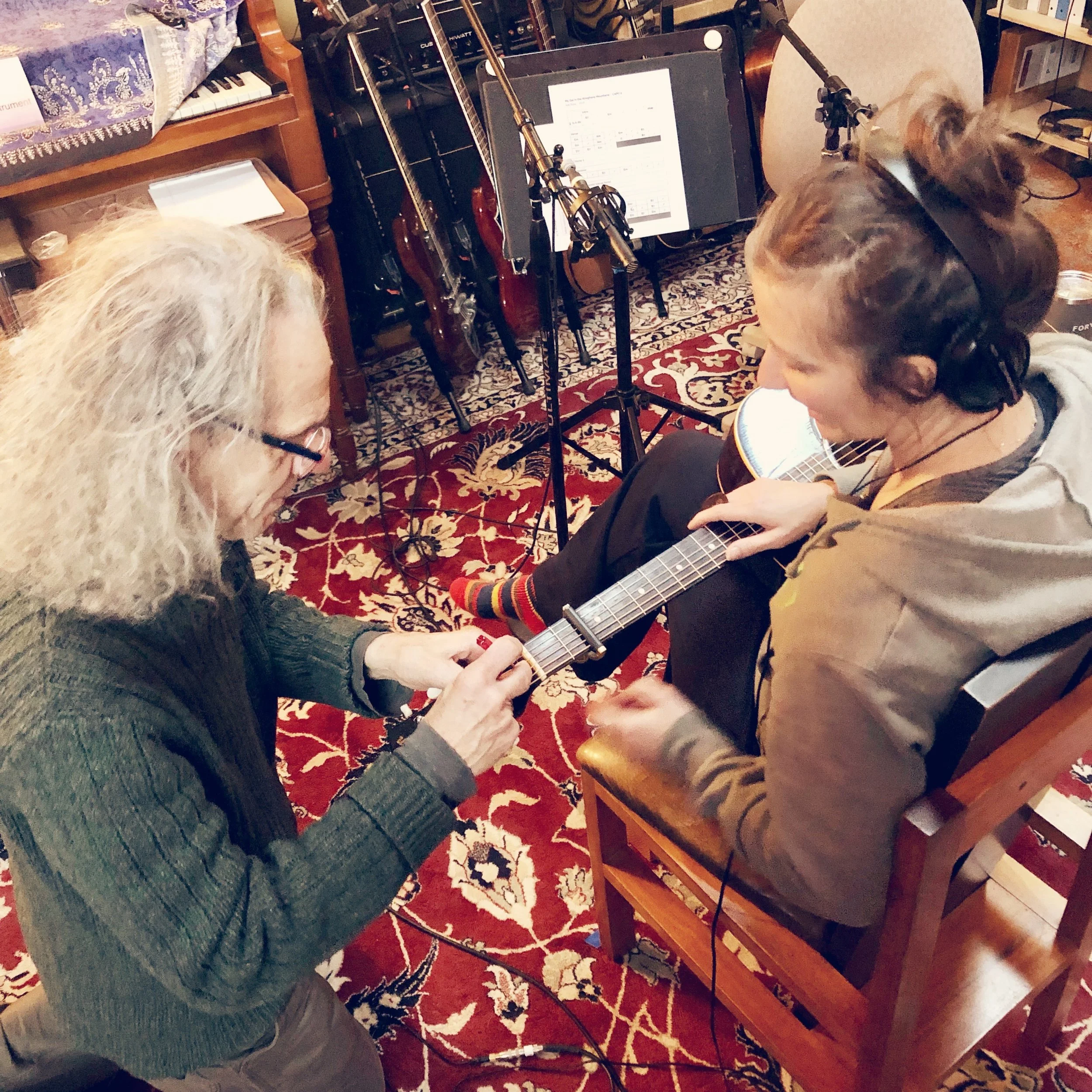
Olivia gets an on-the-spot truss rod adjustment from engineer George Rezendes
So, about this push and pull between being afraid to be visible, while also deeply wanting to share our gifts and inspirations—
I'm well aware that this is ridiculously common.
One reason I know this, is because it's a such a common reason folks come to me to learn improvisation and jamming skills. A lifetime of big and small hurts has left them feeling blocked and scared about just jumping into a social music setting and seeing what happens. What if someone hears them try, and fail?
I also hear similar stories from people who talk to me at live shows. Variations on "you're so lucky to be talented" and "you're so lucky to get to do what you love" flow into admissions of a listener's own yearnings to play music, or live out some other creative dream. But it's too late, too scary, too beside the point of what they've built their life to be.
Then, of course, there's the shadow side of having a public persona online: strangers confusing you with their own projections, positive or negative, and making that your problem. People apparently get quite the kick out of experimenting with the expressive possibilities created by the ability to communicate anonymously, impersonate others, or even to hire social media robot profiles to harass somebody on their behalf. Wild, and maddening when it's aimed at you. But relatable, in a twisted way.
So no, I'm not special, in facing these particular hang-ups around visibility.
And I am, indeed, "lucky to be able to" do what I do, in the sense that I have benefited from many privileges, without which I would not be a full-time working musician, nor the specific artist I am.
(Just off the top of my head: A long list of music teachers, mentors, and community members who invested in my training. Access to a university music education, an entirely impractical student loan to pay for it, and the option to consoloditate that loan at a now-antiquated 3% interest. A native language and nationality that dominate the music industry globally. Federally-funded birth control that has allowed me to choose to focus on my career as much as my male colleagues do. What else? A lot else.)
But none of that means it's not still a ton of work just to show up and be real.
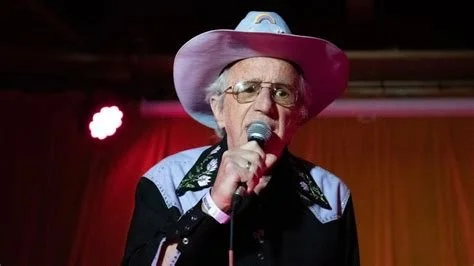
One of my heroes of courageous visibility and self-expression passed away recently. Patrick Haggerty made what is generally considered to have been the first known gay-themed country album, Lavender Country, back in 1973.
After decades of obscurity while Patrick focused on political activism and raising a family, the album was reissued in 2014. It became a beacon to younger generations of queer country artists and fans working to write themselves and their forebears back into the history of the music they've always been part of.
The first time I ever spoke to Patrick was this past May, an interview for a gig playing fiddle with him for a few shows.
“I’ve read your accomplishments; I’m sure you’re qualified musically,” he said flippantly.
“But what I really need to know is: are you up for this? These are intense times, and I am not a person who keeps my mouth shut. In fact... well, I'm a screaming Marxist b*tch! And I’m a bit worried someone will try to shoot me. Everyone who plays with me needs to consider that possibility. Is that something you’re prepared to deal with?”
This was not something I had considered. I won’t say it was a no-brainer. I’m not one to run toward potential trauma, and my approach to politics is about working toward reconciliation and empathy, rather than radical leftist proselytizing.
But here's the thing: I'd been following the Lavender Country story for years. I knew why this music and these shows mattered, whether or not they were happening the way I might have done them.
The first time I listened to the narration disc that accompanied Lavender Country's 2019 album Blackberry Rose, I was moved to tears repeatedly by Patrick’s recount of his rural gay experience, pre- and post-Stonewall.
I knew that helping him share his stories and songs was socially important, healing, timely and relevant work.
“I think we were fated to meet,” he told me at the end of the call.
I got to play two Lavender Country shows this summer. The first one was at a hipster country bar in Portland, OR, which was jam-packed with starstruck millennial queer folks who knew all the lyrics and hung on Patrick’s every word.
“You are the first generation of queers in history to have elders!” he told the crowd. “Isn’t this amazing?”
It was so clear that he wasn’t out there touring and performing at age 78 out of some long-delayed fantasy of being famous. He was doing it because this was the work and the hard-won privilege of intergenerational mentorship.
The other show I played with Patrick was at a ballroom in Tacoma, largely empty save for a handful of Patrick’s activist friends from a bygone era. He still gave all the energy he had (and, perhaps, then some) to the performance, including extended political diatribes with an aggressive edge that made me nervous.
It was a lot more raw than the first show but, again, impressively honest and brave—especially given how easy it is for a performer to fold up into themself when playing to an empty room.
The last time I spoke to Patrick, he was bubbling over about a duets record he was going to make with another gay country artist from Chicago, honoring great female artists of the past like Loretta Lynn and Tammy Wynette. “We are definitely going to need your fiddle on this record,” he told me. “Stay tuned.”
A few weeks later, while out on the road, he had a stroke, and eventually died from complications.
Depressing? Not to me, not exactly.
I mean, I very much wanted to know Patrick longer, and work together more, and I know he’s deeply missed by his husband J.B. and many, many other people.
But I also really admire the way he seized an opportunity to do some powerful social work in his twilight years, and committed himself to it fully all the way to the end.
Even when it scared him.
RIP, Patrick, and thank you for including mine among the huge amount of lives you touched.